The Very Collection in My Library Hymnus Preserved in National Széchényi Library
 2025-12-12


Under the direction of the Ministry of Culture and Tourism of the People's Republic of China, China-CEEC Libraries Union was established in October 2018 in Hangzhou, China, with its secretariat permanently set in Hangzhou Public Library. 64 libraries from China and CEEC, on a voluntary basis, seek common progress made on the principle of "equality, mutual benefit, inclusiveness and openness".
The Very Collection in My Library aims to introduce treasures kept in each member library to audience in China and Central and Eastern European countries and bring ancient books into the limelight, through of which people could enhance their understanding of cultures and histories of other countries.
This episode here is presented by Ms. Judit Gerencsér, the deputy director of National Széchényi Library, introducing you the autograph manuscript of the Hungarian national anthem Hymnus.
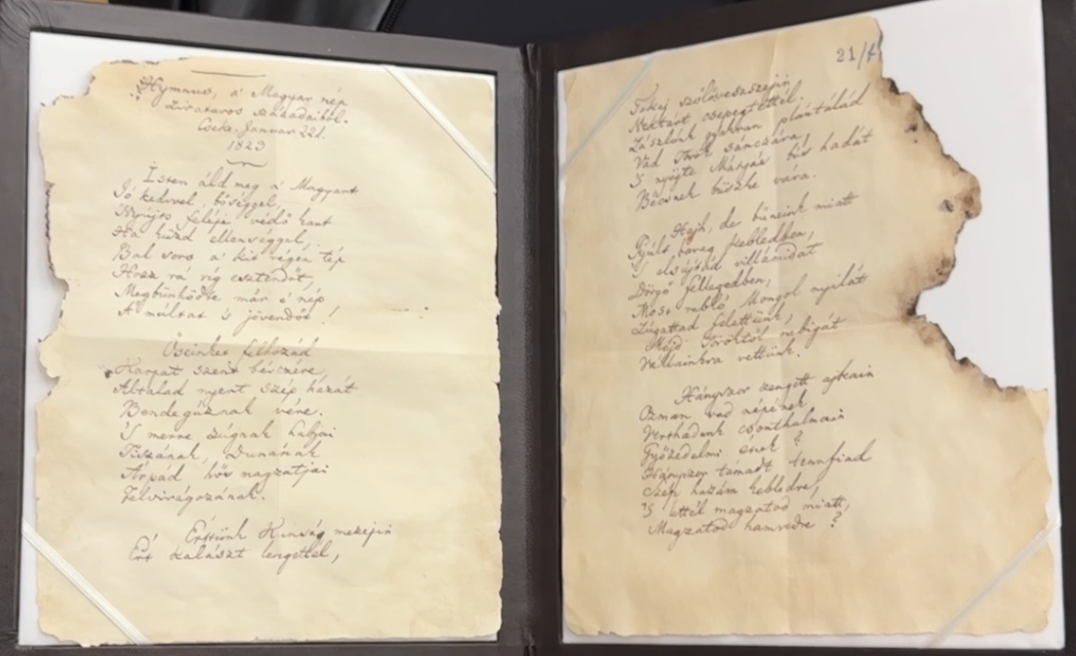
The only surviving, damaged autograph manuscript of the Hungarian national anthem is preserved in the National Széchényi Library. Its author, Ferenc Kölcsey, was perhaps the most erudite Hungarian literary figure of his age—poet, translator, aesthetic thinker and critic. His creative and private life was marked, almost from the beginning, by alternating periods of hope, turmoil, and resignation. Unable to make a living from literature, he was compelled to manage his family estate in Szatmárcseke, far from Pest, the cultural centre of the country, and from his literary friends.
Hymnus was written during one of the most difficult periods of his life, in the early 1820s—a time of deep melancholy that bordered on depression, spent in almost complete, self-inflicted solitude. Looking back years later, he wrote to his closest friend, Pál Szemere, that there had been a year when he had not even stepped out into the courtyard of his manor. He also mentioned the writing of the Hymnus, though without describing the creative process. He does, however, reveal that he was studying and experimenting with the tone and voice of Hungarian folk songs.
A central element of Kölcsey's thought was the examination of the Hungarian past—and, through it, the present. Past events, whether glorious or tragic, uplift both poet and reader, shaping reflections on the nation's future and guiding its actions. Within this emotional and intellectual context the Hymnus was born: a prayer to God, the Lord of History, for the nation's future. The poet appears as the spokesperson of the people, in strong resonance with the Biblical King David; the poem's basic situation draws from Psalm 130, one of the penitential psalms.
The opening and closing invocations frame a historical survey. Two stanzas recall God's blessings—conquest of the homeland, natural riches, military successes—while four depict the consequences of divine wrath: Mongol and Ottoman devastations, internal strife, exile, hopeless struggles, and a world where merit no longer earns freedom. The poet acknowledges that the nation's sins brought about its suffering, yet the extent of its trials now exceeds its guilt; only God's mercy can restore balance.
For decades, Kölcsey's Hymnus was regarded simply as an outstanding poem shaping national historical consciousness. It became Hungary's anthem thanks to Ferenc Erkel, who set it to music in 1844, and by the late 19th century the combined work of the two creators had achieved its revered, emblematic status in Hungarian cultural history. The date of its creation, January 22, is also celebrated as the Day of Hungarian Culture.
Dynamic recommendation

European Art Museu...

China-CEEC Librari...
